
Though this article was first published more than two decades ago, much of the common sense advice included still applies, so I hope you’ll find it helpful in making your own plans.
If it hasn’t happened to you already, sooner or later, it will. You’ll be innocently surfing the Internet – perhaps researching the village where your great-great-grandparents lived before crossing the pond – and an overwhelming urge to go to this ancestral hometown will sweep over you. Or maybe you’ll find yourself entranced with the notion of joining the old country tour advertised in your favorite genealogical society’s newsletter. Or your best friend will return home with three fresh generations appended to her family tree because of a research spree in London and you’ll find yourself just a tad bit jealous. Some way, someday, somehow – you’ll find yourself with a hankering to go explore your European roots firsthand.
I’m very fortunate in this respect. Having been an Army brat, I was born in Europe and made my first trans-Atlantic trip before I was a year old. Since then, I’ve wandered around more than 70 countries scattered across all the continents. By most measures, this makes me an experienced traveler, but even I was not prepared for some aspects of genealogical tourism. This article will not be 27 steps for organizing your genealogy trip to Europe, but rather, what I wish I had known before my roots-oriented journeys – journeys which have taken me from Ireland to Ukraine and from spontaneous solo jaunts to well-orchestrated, customized group excursions. It’s my hope that sharing my “lessons learned” will help you avoid a few pitfalls and have a more enjoyable experience when you venture to Europe.
A good place for us to start is with your travel objectives and style. Before you even surf for options or pick up the phone to call your travel agent, ask yourself a few questions.
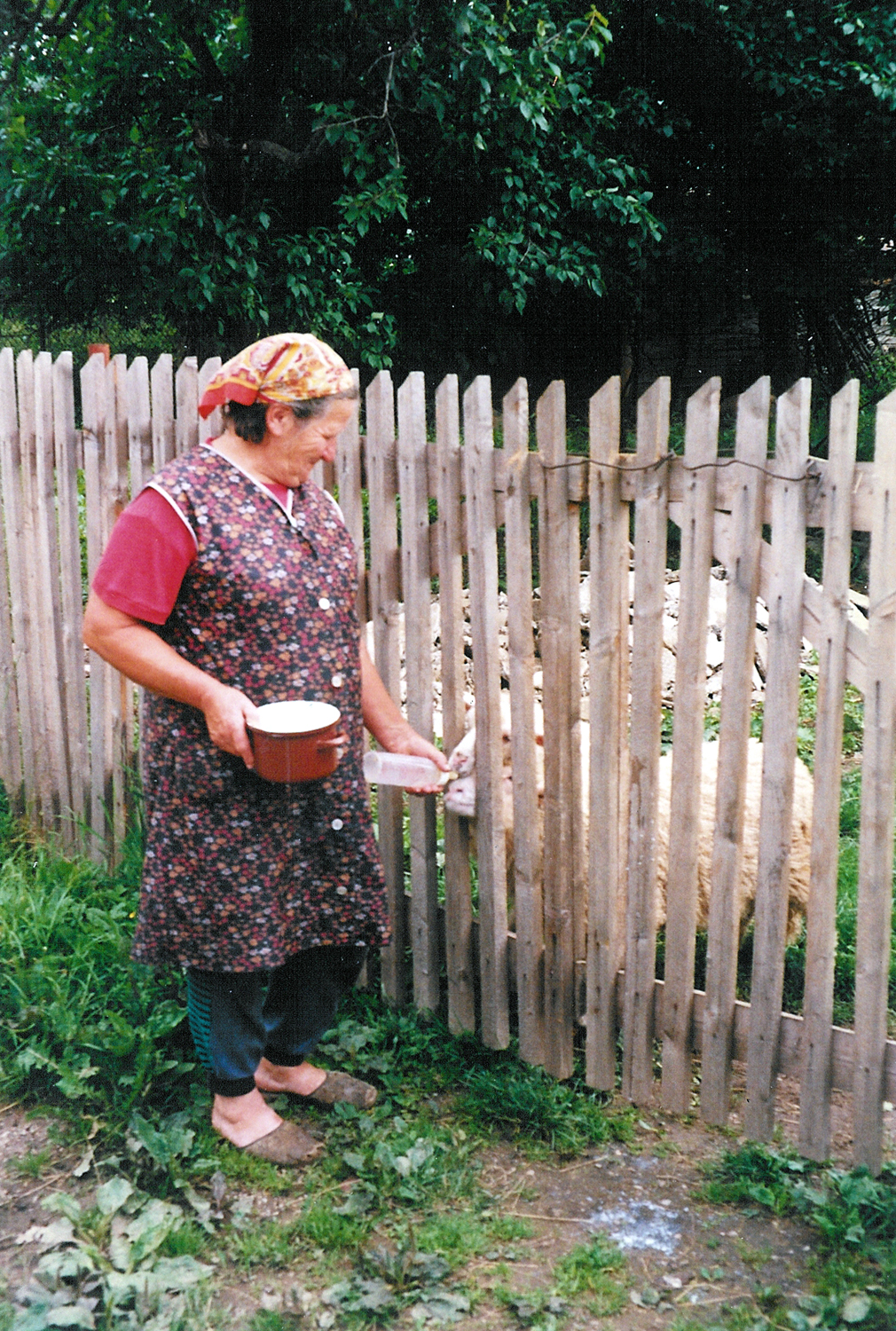
In many places in Europe, you’ll feel as if you’ve walked into a living time capsule.
What’s Your Focus?
The first factor to consider is what you hope to accomplish during your trip. Are you more interested in burrowing in for some in-depth research in an old world library or are you more excited about the prospect of meeting some distant cousins? Do you want to discover the paper trail of your ancestors or more literally walk where they once walked? Do you want the focus of your trip to be genealogical or do you want to do some general sight-seeing, too? Do you want to go to just one of your ancestral homelands or several? Will this be the first of a series of trips to the old country or the only time you’ll ever go to Europe?
I should probably mention that it’s my experience that a taste creates a desire for more. On the group trips in which I’ve participated, there are usually quite a few people who start out saying this is their first and only trip to Europe, but by the end, they’re already making plans for their next voyage. In fact, I’ve seen some of these self-proclaimed once-in-a-lifetimers on their second trips! So if you fall into this category, you might want to give yourself some breathing room by not pressuring yourself to do it all during one trip.
Organized or Free-Wheeling?
We all have our own travel styles. Some of us like structure and minimal surprises. We enjoy the journey, but want to know when our meals will be served, what we’ll be seeing, what our hotel rooms will be like, and so forth. Others of us are rather free-wheeling, preferring to make only sketchy plans that we’re apt to change on the spur of the moment.
When it comes to genealogical travel, both styles have their advantages. The organized ones – the ones who, for instance, find out where the archives are (not to mention, their hours, requirements and assorted quirks) in advance – will probably come home with more details for their family tree. The free spirits, by contrast, are the ones who just drive into the village and start knocking on doors. This approach is a bit of a gamble; they may come up empty-handed or they may be welcomed like the proverbial prodigal son. Instead of data, they’re likely to come away with experiences and some good stories.
Group or Solo?
Similarly, some folks love traveling in groups, while others find doing so confining. Again, there are pros and cons to both styles. Groups generally have a little more clout. When hotels and restaurants see the potential income, they might provide special treatment, such as free local transportation or entertainment at dinner. If something goes wrong (say, your toilet is leaking), your voice carries more weight (even in the former Eastern bloc, where some companies still haven’t grasped the concept of customer service) because the facility doesn’t want to risk losing the business of the whole group. And in general, those in groups save money due to economies of scale.
Of course, solo (or small clusters of) travelers can also benefit from special treatment simply because they are so few in number. I’ve stayed in a privately owned castle in Belgium, taken an unexpected side trip to Vienna with a Holocaust survivor, been whisked away to a Bruce Springsteen concert in Paris, and had many other mini-adventures simply because I was alone or with only one companion. Such kindnesses can be bestowed on one or two people, but not on a crowd of 20.
Safety is another issue. Most people feel safer in groups, but my experience is that there are risks when you travel, period. When traveling by myself, for example, I’ve had to fend off drunks or unwanted attention in trains in Belgium, the former Yugoslavia, Italy and Ukraine, but it’s also true that large packs of tourists make a tempting target to thieves. One person (out of a group size of 40) was robbed during each of two reunion trips I joined to Slovakia – one on public transportation during a visit to Vienna and one off the tour bus in Bratislava (the driver had failed to secure the bus as we were checking into the hotel).
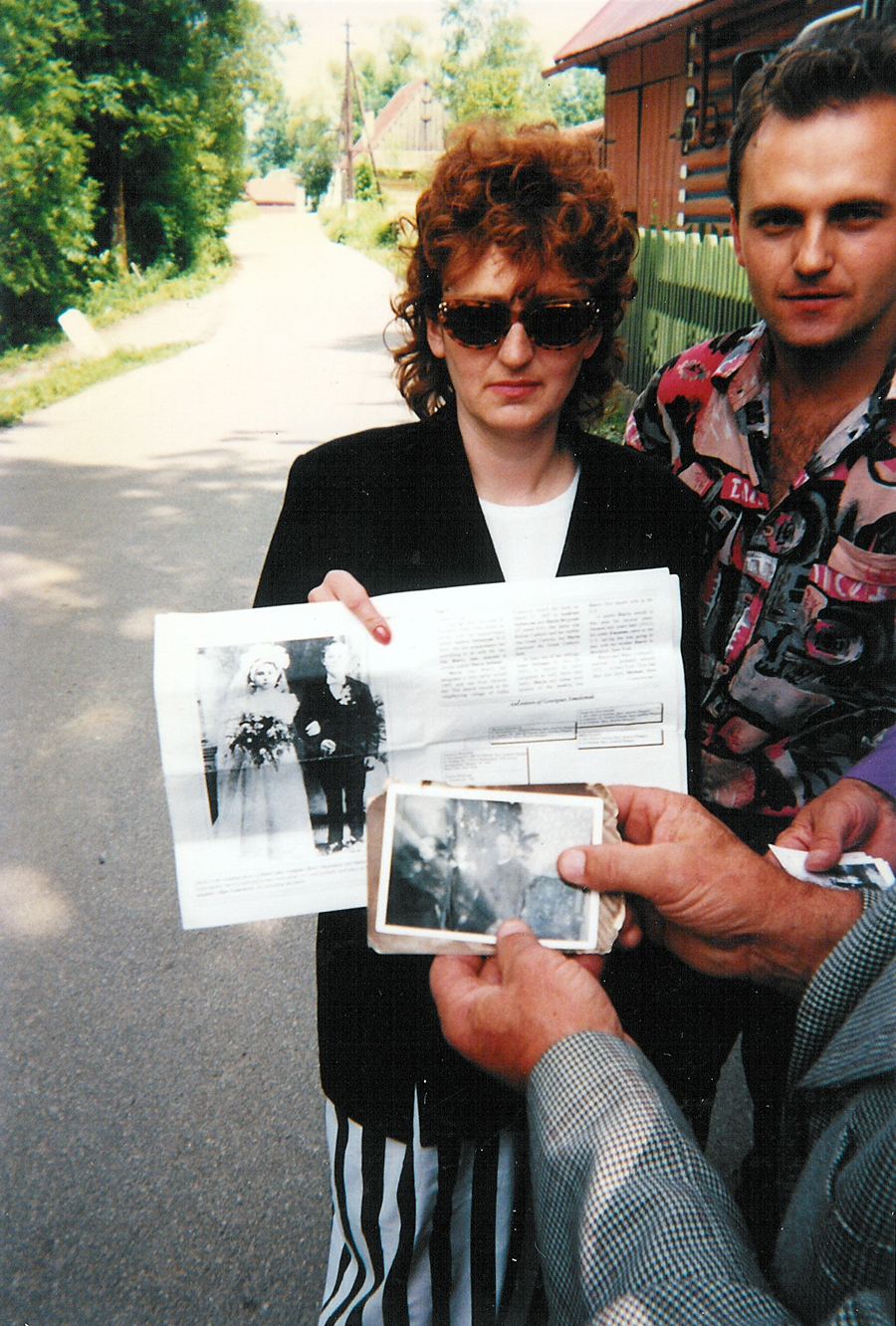
European and American cousins compare photographs of common ancestors.
What’s Best for You?
The answers to all of these questions are best considered before you even start researching possible tours or itineraries. And I would be less than forthcoming if I did not say that some compromise will be necessary (unless you’re fortunate enough to have plenty of time and money!). If you go solo, you can do exactly what you want, but you will likely spend more and will certainly have to be more self-sufficient. If you go with a group, you will be locked into their itinerary without consideration of whether you’re an early riser or really want to go to that lace museum, but all the details and usual headaches (such as luggage) will be handled for you. If you want to spend time in the village, you may discover the archives won’t fit in your schedule.
There are countless trade-offs. The key is choosing or planning a trip that will satisfy as many of your requirements as possible, so I would suggest outlining everything you’d like to do and every place you’d like to go – and then backing off a little. It’s our nature to be overly ambitious and then be disappointed when we can’t squeeze it all in, but mishaps happen when you travel. Perhaps the train is late or the driver didn’t show up. On one trip I helped organize, we had a person who missed her flight from the U.S. (she hadn’t allowed enough connecting time). When we arranged for a pair of people to backtrack and get her from the airport the following day, they got in an accident on the way. Meanwhile, another person wound up having to be suddenly hospitalized for what was eventually diagnosed as diabetes. And that was just one trip. It’s true this is an extreme example, but you’d be wise to anticipate something not going according to plan. If you’re willing to let go of one or two of your objectives or to drop a city or two from your dream itinerary, you can usually create enough buffer time around what remains to accommodate hiccups, as well as allow you take advantage of happy accidents that might occur (such as an invitation to a newly discovered relative’s wedding).
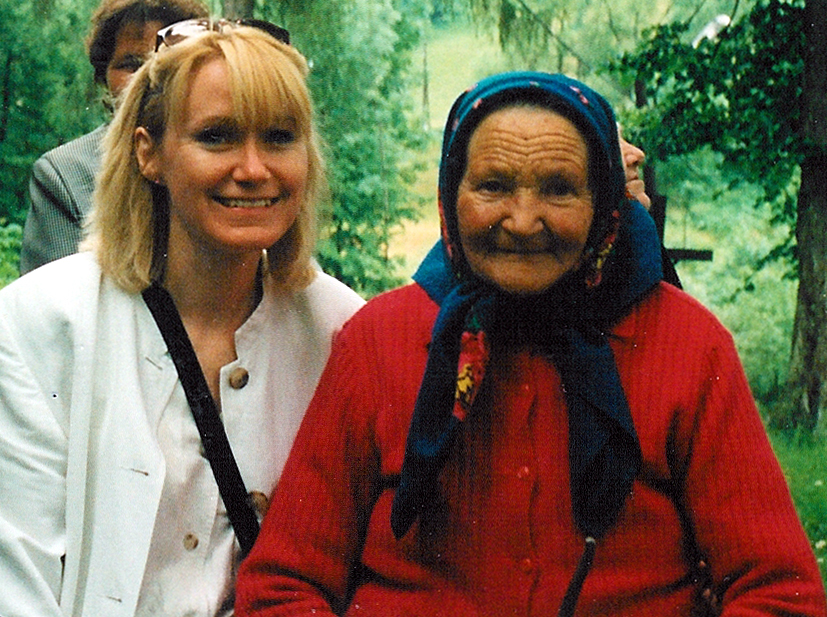
East meets West in the old country. Westerners visiting Eastern Europe are often treated like visiting royalty.
Choosing a Vendor
Once you have a clear idea of your preferences and priorities, then it’s time to start dealing with travel agencies, airlines and so forth. By this point, it will probably be quite apparent whether you’re better suited for solo or group travel. If you’ve decided to go solo or with just one or two companions, you’ll have both the luxury and the burden of crafting a trip that maps as closely as possible with your ideal scenario. And chances are, if you’ve elected this approach, you’ve done it before, so you don’t need much coaching.
Most people, however, opt for a group trip of some sort, so the next step is finding the offering that best suits your desires. Fortunately for us, travel agencies have come to recognize the potential of roots travel, so there are many more options than there were even a few years ago. To give you a running start, I’ve assembled a list of 18 companies* that have genealogically-oriented trips to Europe, but don’t limit yourself to these.
Try checking out any genealogical societies that might organize trips. The National Genealogical Society, for instance, periodically sponsors research trips to England, Ireland and Germany. Ethnic societies are another good source. By way of example, the Carpatho-Rusyn Society runs annual tours to Poland, Ukraine and Slovakia. To see what might be available for your country of interest, enter “genealogy, tours, country,” (substituting Italy, Germany or whatever for “country”) at your favorite search engine and explore the sites that pop up.
You’ll probably discover that availability is uneven. For some reason, there’s a bit of a bookend effect with Europe with the western and eastern portions being more heavily covered than the middle (perhaps because there’s such interest in the British Isles and a more marked need for assistance in Eastern Europe), but you should find at least a company or two for any country you research.
As with any major purchase, you’ll have to do your homework. Don’t be shy about asking questions. Some you might want to consider include:
- How long have they been in business? (Several of the companies I discovered during the course of my research for this article had already gone out of business, but are still strewn across the Internet.)
- How many trips have they arranged to this country before? (Many specialize in just one country, but if they cover several countries, you’ll want to be sure they have adequate contacts and resources to get you the best accommodations, prices, etc.)
- Can you have some references? (You’ll want to speak with others who have traveled with them before. Even those who are hand-picked by the company for their favorable comments will tend to be quite honest in response to direct questions.)
- Do they specialize in genealogical research in that country or work with someone who does? (Because they see dollar signs in the genealogical market, some companies now target us as customers, but when you inspect their itineraries, you’ll see that all they’ve done is incorporate a half-day at a national library or a lecture by a historian. Don’t fall for this! Ask specific questions about which repositories they include and whether there will be any local professionals assisting you.).
Customizing Your Journey
As you research possible trips and tour companies, the need for compromise will re-emerge. Perhaps you’ll want a ten-day trip, but only find one or two week options. In such cases, you’ll probably have to practice a little flexibility or look for another vendor.
But the good news is that if you start early enough, you may be able to reduce the need for compromise. Let’s say, for example, that you find several itineraries that are close to what you want, but are just a little shy of what you had hoped for. Maybe you’ve found a couple of tours that visit an important national sight just 30 miles from where your great-granddad lived, but don’t go to your ancestral hometown. So close, and yet so far! In such cases, you may be able to request adjustments. Quite a few companies specializing in genealogical travel have encountered this particular situation frequently enough that they now provide add-on services, such as arranging for a private car and translator for side jaunts.
The key is to ask for such itinerary tweaks in advance. Some may be able to make such arrangements on the fly, but even if they can, you will probably pay more, be at the mercy of someone they haven’t worked with before, or otherwise diminish the experience. I know from personal experience from the time I requested a car and translator for a quick trip to a village in Ukraine. The car and driver were fine, but the translator was the driver’s teenaged daughter whose skills were so poor that she created more confusion than if I had just shown up by myself without any language assistance.
Of course, if you are independently wealthy, you may wish to consider customizing your entire trip. There are a growing number of companies that cater to families or small groups of perhaps three to six people. This would be ideal if, say, you and a few of your siblings would like to visit three ancestral hometowns now scattered among three different countries. And I should point out that if you’re dealing with Eastern Europe where costs are much lower, this might be in the realm of the possible even if price is somewhat of an issue for you. Yes, it would cost you a little more than joining that bus tour, but such a customized experience could be potentially priceless.
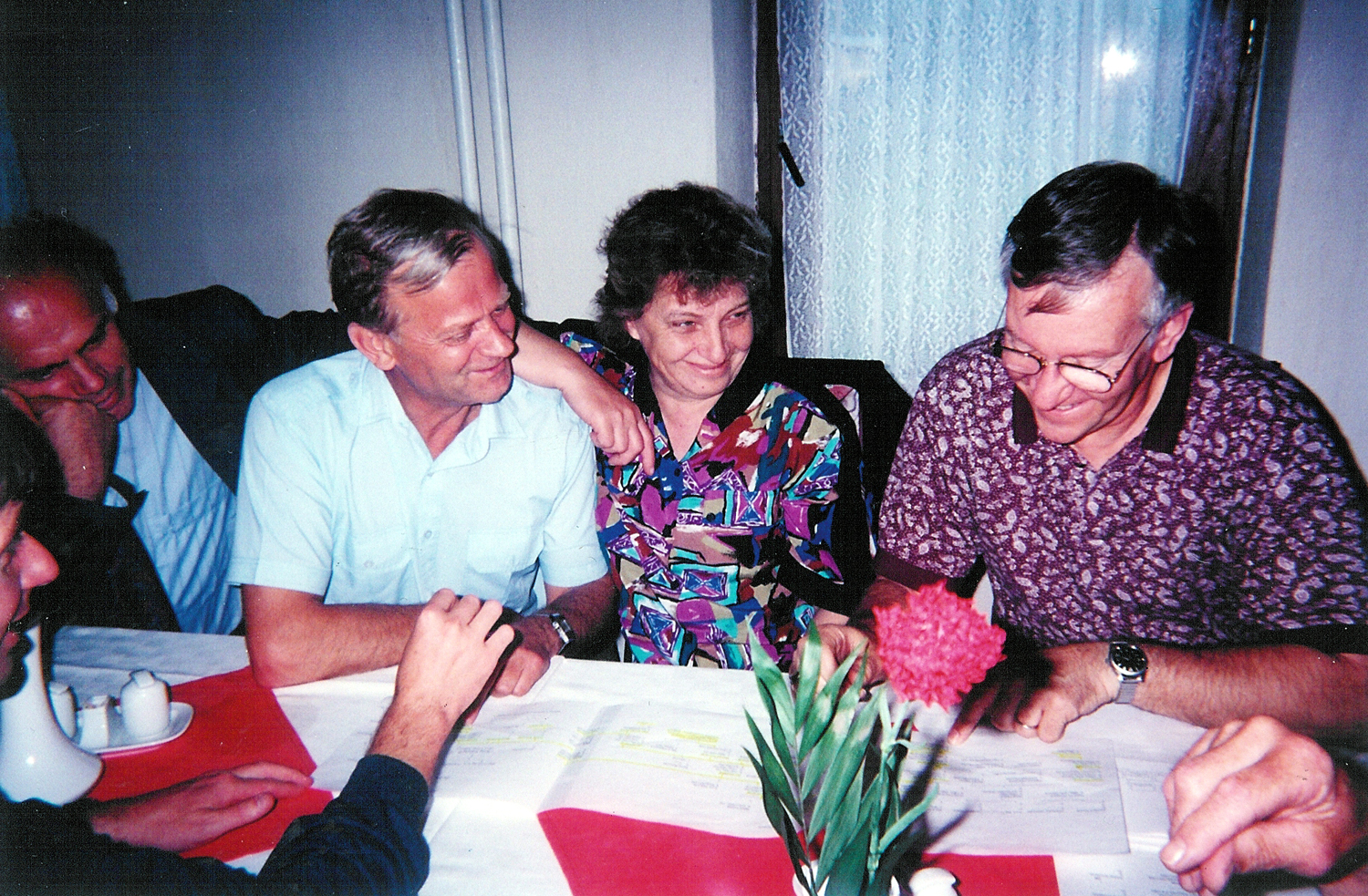
Trans-Atlantic cousins pore over records to find the connections.
Translators, Transportation and Genealogists
Whether you’re flying solo or going with a group, be sure to give these three factors special consideration. If you’re part of a generic sight-seeing tour, these won’t be such an issue, but when you toss genealogy into the mix, these three become very important.
Yes, it’s true that we can get away with English almost anywhere in the world, but the further east you go in Europe, the less you should count on skating by on the kindness of strangers. And even if you’re with a tour group that has translators included, there will never be enough. For example, when I participate in trips to Slovakia, I always arrange for my own translator. This way, I don’t need to worry that all the translators will already be assigned when I want one to go with me to a relative’s house. In my experience, most translators also make convenient cultural guides, as you can quickly consult them to learn the appropriate way to respond to a request to drink milk straight from their cow or the local equivalent of moonshine at eight in the morning (if you go east of Vienna, it will happen to you!).
Transportation is another critical factor. I have no problems driving stick shift or on the “wrong side of the road,” for instance, so when I visit Ireland, I simply rent a car and drive myself. In Ukraine, by contrast, “gas stations” are often in someone’s backyard and even if I magically knew where they were, I wouldn’t be able to communicate with them once I got there. Add to this the fact that sporting a North American accent in some Eastern European countries is tantamount to having the word “bank” stamped on your forehead. Police will randomly pull over cars and dream up infractions to get a little “consideration.” Border officials will claim your visa is invalid for the same reason. In fact, this last has happened to me so often that I refer to my standoffs with customs officials as border picnics, since they often result in me settling down in a cold car for hours at a time with whatever snacks and amusement I have on hand.
And then there’s the matter of genealogists. Again, if you’re traveling in England or Ireland where you speak the language, you can probably get by without professional assistance. Even so, you might want to secure some help – at least during your first visit – to help you master the peculiar hours, identification requirements, requesting processes, and the like. Doing so can help you maximize the time you have there.
And once again, the further east you go, the greater the need for help becomes. Yes, you may have a translator with you, but what if he doesn’t know what an urbar or serf is? How will he communicate what you’re looking for? Furthermore, repositories can be quirky. They may view North Americans as pesky visitors who expect instant miracles, but this can often be overcome if you appear with a well-respected local. Such people also tend to know work-arounds for special situations, such as the fact that the archives has a copier, but can’t afford paper for it. If you know this in advance, you can bring your own paper and the problem is solved. If not, at a bare minimum, you’re going to lose some valuable time paper-shopping.
It’s critical to know your limits. As I mentioned at the outset, I’m a reasonably experienced traveler, but I don’t scrimp on translators, transportation or professional genealogical assistance. Each country is different, but it’s better to overestimate your needs and perhaps seek cost-sharing opportunities (surely someone else will be interested in joining you in a trip to the archives) to bring the expense down.
What to Expect
So now you’ve made all your arrangements and are about to embark on your trip. What can you expect? In all likelihood, you will be given far more credit for showing up in your ancestral hometown than you deserve! Yes, there are places such as Ireland where so many roots-seekers have visited previously that you might be greeted with relative indifference. But even in such places, for every person who smirks, there will be another who will welcome you warmly. And some will be genuinely thrilled to see you – even though you’re just another North American – because you’re their kin!
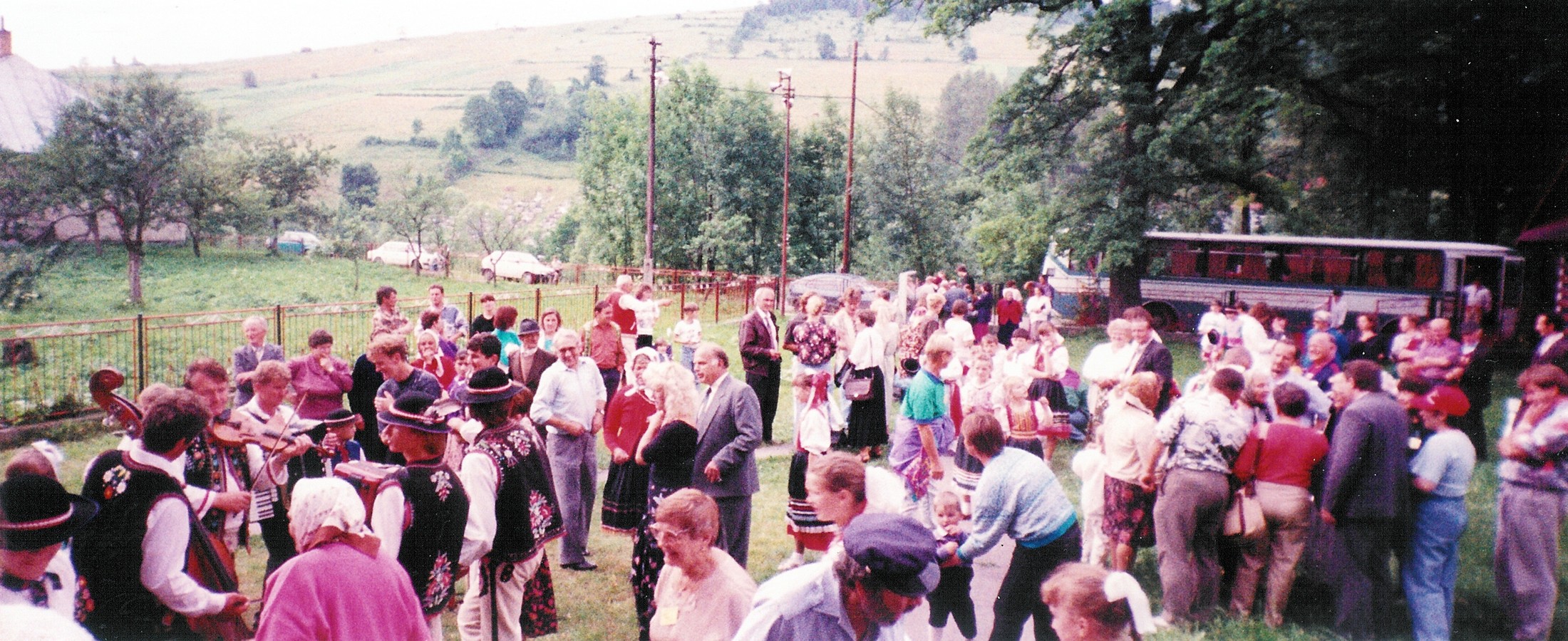
American cousins threw a party in the town hall for their hosts and the festivities spilled out on to the lawn. Note the tour bus in the distance.
For the most part, though, we are treated like visiting royalty. On my first trip to Slovakia, I was given honorary citizenship by the mayor. My niece and I stayed in his luxurious featherbed, not realizing that he and about a dozen visitors were freezing their tails off in an uninsulated attic room (I only found out when I watched a circus-car-like procession of people climb down a ladder one morning). We were given the best food and the best drink, as well as access to all the records we cared to search. Other relatives came from all over Slovakia and even the Czech Republic to meet their trans-Atlantic cousins.
This royal treatment is generally the standard even if you show up unannounced. Usually, the first person you encounter will shuttle you to the mayor or perhaps a church official. Before long, records books will be brought out or the oldest person in the village will be escorted in. One way or another, these people will make it their mission to find you a cousin or two before you depart! You’ll want to be sure to bring some genealogical charts and a few copies of old family photos for such occasions. Names and dates are easily understood in most languages, so your charts will facilitate the cousin hunt. And pictures seem to have a magical quality. I’m one of the many who’s experienced the pleasure of having someone in the old country appear with a photo identical to one I’ve brought with me – a moment that tends to underscore the kinship, even if very distant.
All of which brings us to the topic of how you will repay their hospitality. At a minimum, you should plan on bringing a batch of small gifts to pass out – t-shirts and the like (ones associated with favorite sports are a good bet in almost every country; soccer and hockey team items tend to go over well in Europe). If you’re traveling with a group, work with your tour operator in advance to arrange your own event to reciprocate. If you each kick in a little extra, you may be able to host a large dinner in the town hall and bring in some local entertainment. Take lots of pictures with everyone you meet because a favorite gift is an enlarged, framed photo of you and them sent back after the fact.
And finally, take a look around and see what the town needs. Is there a way you can help? During one reunion, we held had a spur of the moment raffle (the prize was a handcrafted replica of a local log home that a young man from the village had sold to one of us) and raised $1,000 toward the renovation of the local church overnight. We’ve continued with sporadic fundraisers for the church since then and periodically send additional contributions. Doing so is good for the village, at least partially repays the kindness of those who live there, and helps ensure that our descendants will be able to visit the same church decades from now. A little creativity goes a long way when it comes to reciprocity!
Bon Voyage!
If you’ve ever considered a trip to the old country for even five minutes, please do yourself a favor and make the commitment. I’ve compared notes with countless genealogical travelers and have yet to encounter one who was disappointed – and that includes the fellow who was hospitalized with diabetes! It’s an incredible experience, and with a little common sense and preparation, it can be one of the most memorable and meaningful of your life.
Megan Smolenyak Smolenyak, author of Honoring Our Ancestors: Inspiring Stories of the Quest for Our Roots, In Search of Our Ancestors, and They Came to America: Finding Your Immigrant Ancestors, can be reached through megansmolenyak.com.
Originally published in Family Chronicle, June 2004.
*Not surprisingly, many of the companies included are no longer in operation, so I’ve excluded this list.






Leave A Comment