
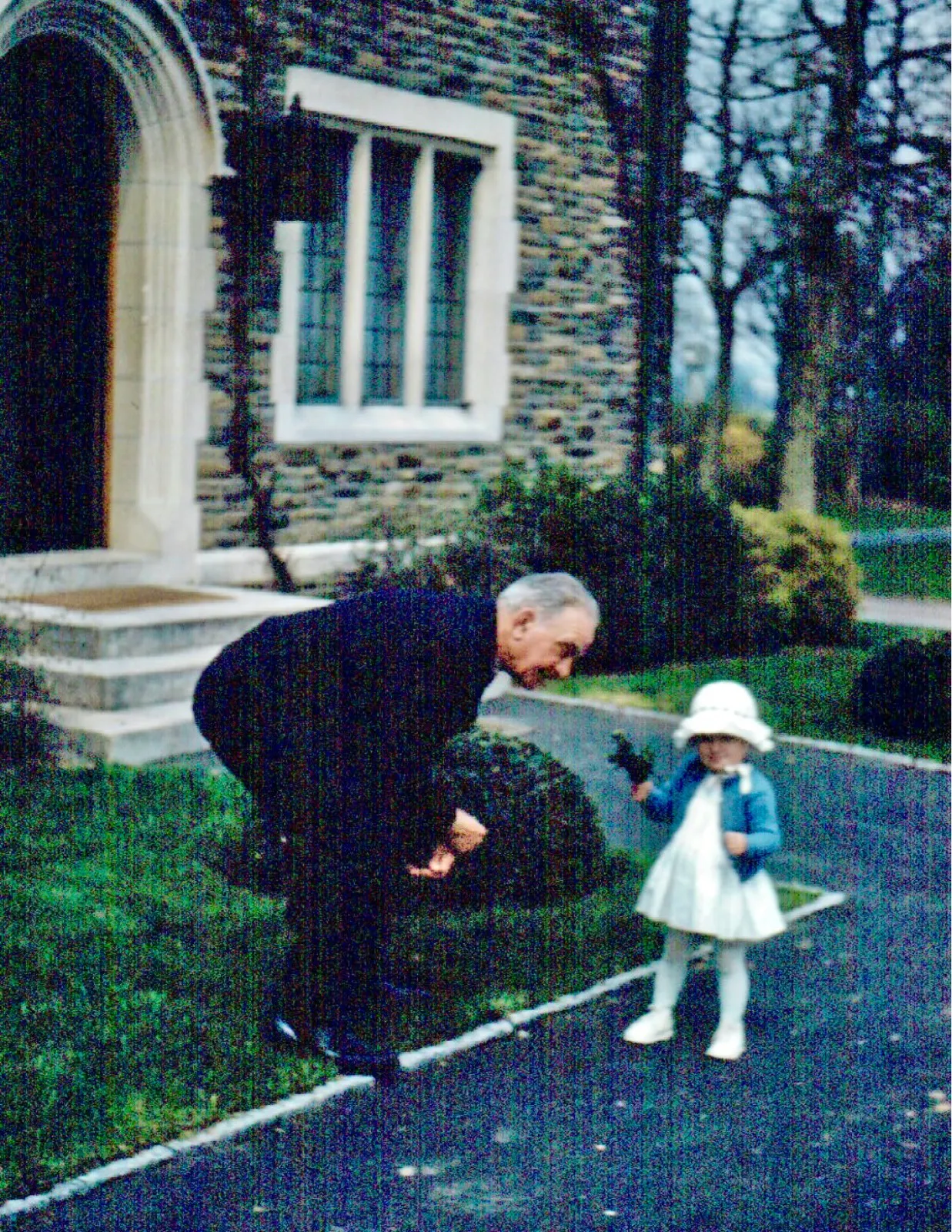
Aisne-Marne Cemetery caretaker and me as a youngster
I was born into an American military family stationed in France, and as the first child of young parents (20 and 24 at the time of my arrival), had the good fortune of being carted along on a number of European adventures during my toddler years. My father, George C. Smolenyak, was an avid photographer, and like some at the time, had a preference for slides over pictures. As a result, assorted moments from my earliest years have been preserved in these miniature transparencies.
My father was a meticulous man with a remarkable memory, so could easily rattle off locations and other specifics decades after the fact — details which inevitably matched the labels he had recorded on the slides’ edges when he first created them. Dad had a few favorites he enjoyed telling stories about, such as my first encounter with snow in the Pyrenees or that time I kept everyone in a small hotel awake with my bawling, but there was one in particular he told repeatedly.
His tidy script notes that it was the “American caretaker, Belleau Woods Cemetery, France” and the slide shows this man bending over to chat with 18-month-old me. I’m clutching a branch he had apparently just handed over.
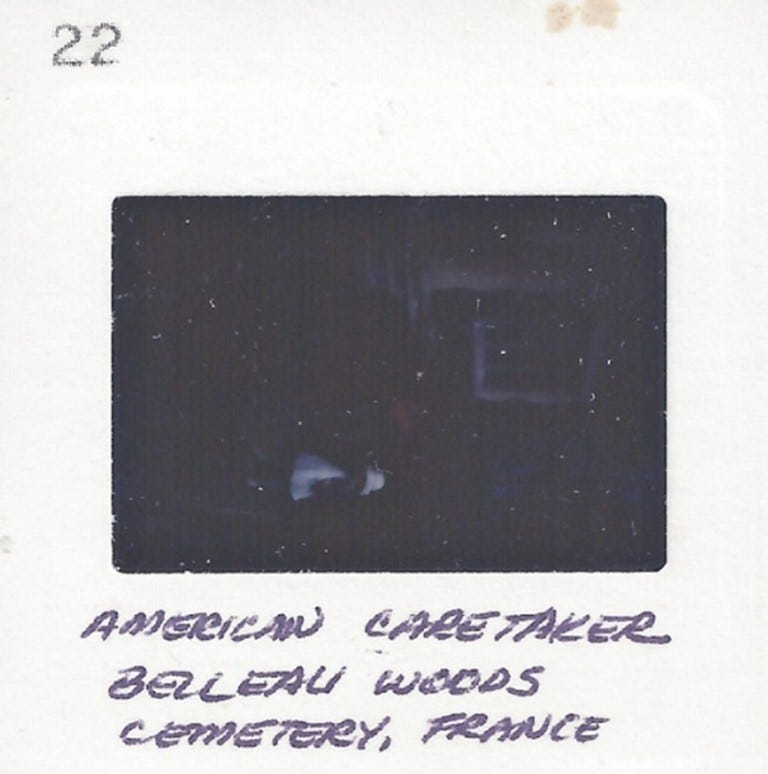
Dad’s caption on the slide
Time and time again, Dad explained that this gentleman was an American soldier who had served in World War I, stayed in France and married a local woman, and worked at Aisne-Marne Cemetery where 2,289 Americans are buried. When my father asked him while he had remained in France, he responded simply, “To take care of my buddies.”
This moment-in-time has always been special to me — partly due to Dad’s vignette and the snippet of my history it holds, but also because it foreshadows my later experience. I’ve spent years working with the U.S. Army assisting with the on-going effort to identify our soldiers who are still unaccounted for from past conflicts ranging from World War I to Vietnam. As it happens, I recently reached a random but timely milestone of having researched 1776 soldiers as of this year, America’s 250th anniversary. In my mind, this snapshot captures the instant this amiable veteran had just passed the baton so I could one day also help take care of his buddies.
For this reason, it has tormented me that I didn’t know who this man was. I asked Dad several times hoping that his impressive memory would suddenly toss out a name, but no such luck. But I’m a professional genealogist. I should be able to unearth his name, right?
It wasn’t for lack of trying, but as those who are familiar with American records know, our twentieth century military personnel records are sketchy at best since so many went up in flames (or were swamped by water) in a 1973 fire. So how could I find him? All I knew was that he had served in WWI, married a French woman, worked at this cemetery, and was still there in the 1960s. Where to start?
Then it occurred to me. What about those record sets for Americans living abroad? Ancestry doesn’t make them prominent, but if you search their catalog for relevant collections, you’ll pop up several including the following:
U.S., Consular Reports of Marriages, 1910–1949
U.S., Consular Posts, Emergency Passport Applications, 1915–1926
U.S., Consular Registration Certificates, 1907–1918
U.S., Consular Reports of Births, 1910–1949
U.S., Consular Registration Applications, 1916–1925
U.S., Reports of Deaths of American Citizens Abroad, 1835–1974
U.S., Registration Certificates — Widows, Divorced Women, & Minors, 1907–1914
I didn’t have a name, but did I perhaps have enough other information to ferret him out? I took a dive leaving the name fields blank and entering “Aisne” and “Belleau” instead in location and keyword fields. Most came up empty, but I eventually got some hits with the 1910–1949 birth index. Seven children had been born to six couples in the relevant vicinity and time frame. Of course, I didn’t know for sure that my mystery man had any children, but it seemed a reasonable possibility, so now it was a matter of narrowing the field.
I researched each of the six men. Not surprisingly, all had married French women, but a couple had birth dates that suggested they were too old to be the fellow I was seeking. Another struck me as unlikely as he was a naturalized American citizen from Romania, and my father, hailing from a Slavic family himself would have inevitably remarked on the man’s origins and accent. But all this was a bit speculative. Fortunately, I was able to eliminate several because U.S. records showed that they had moved back to the States well before the 1960s. I was soon down to two. What could I use as a tie-breaker? Maybe passport photos? Yes! Both had photos taken in the 1920s. One of them was almost bald even as a young man, so it had to be the other one.
I was now looking at Charles William Anderson along with his wife and daughter. After all this time, I finally knew his name, and it made me smile to have spotted him with his own toddler.
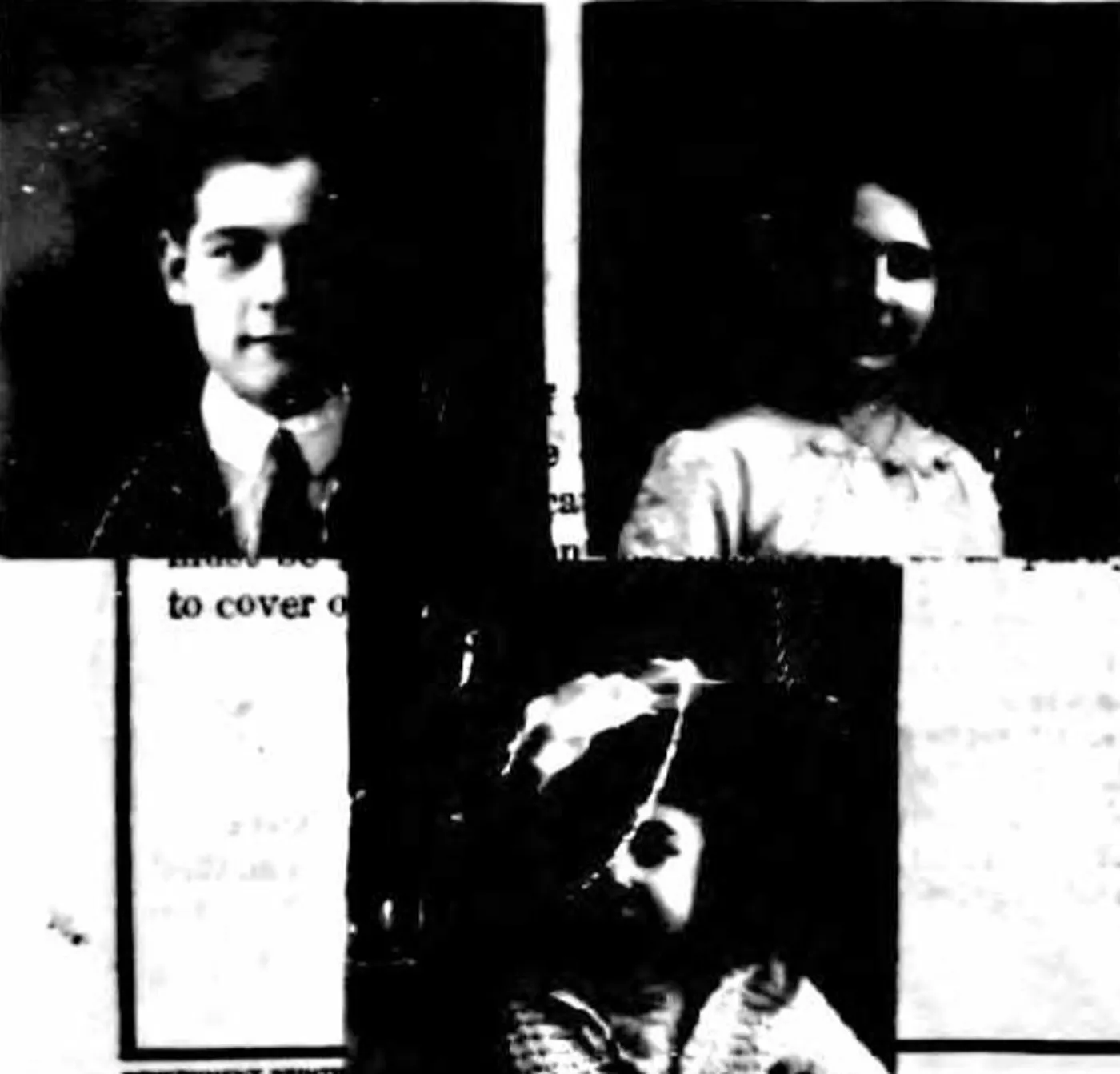
Passport photos as seen on Ancestry
I’ll detour for a moment for those who might be new to research to mention that it’s often worth checking whether a particular resource is available in more than one site as a quick look into FamilySearch’s full-text collection turned up a much cleaner version of this same image.
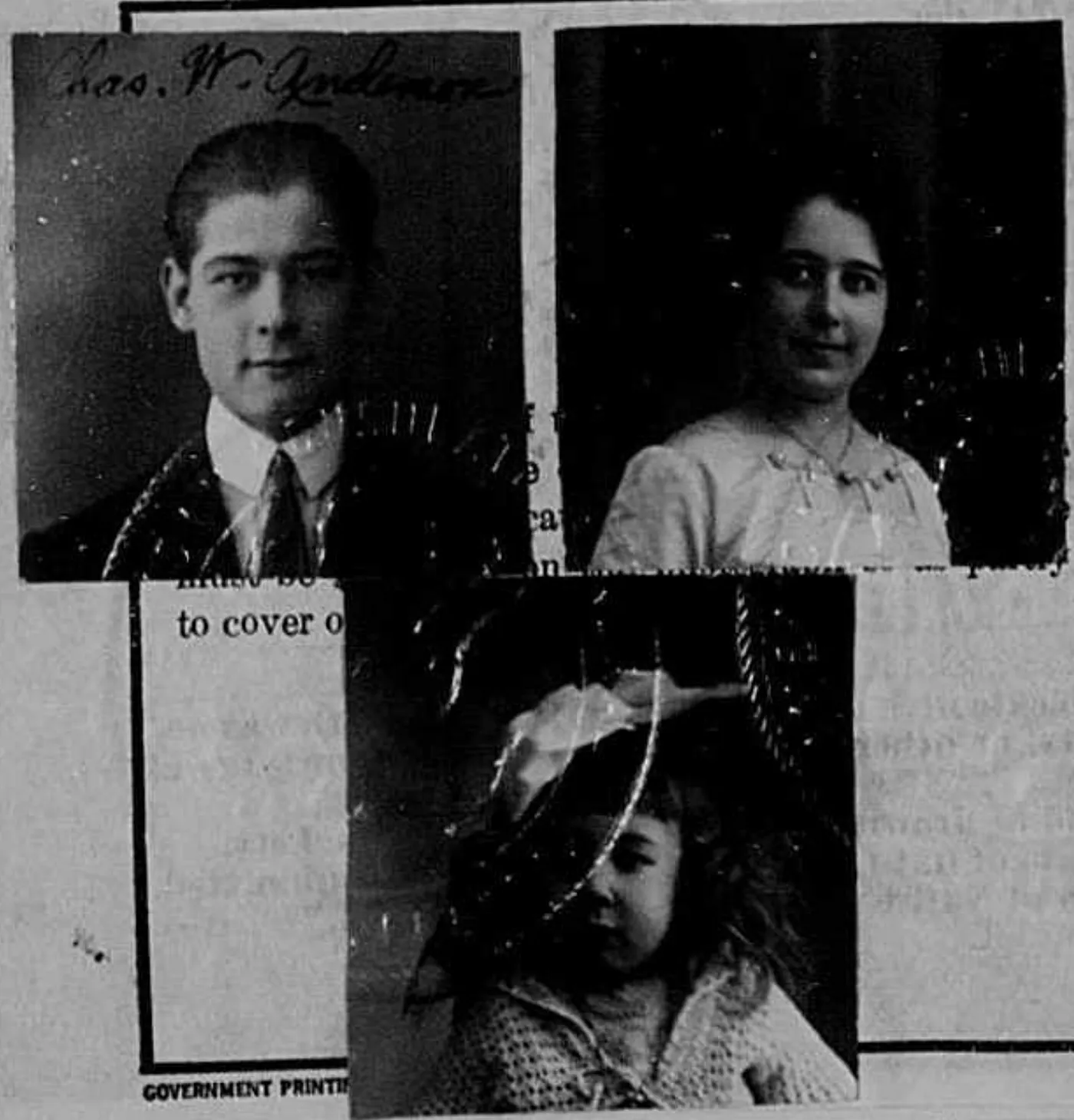
Same photos as seen in FamilySearch’s full-text collection
I was confident I had the right man, but genealogists can never get enough substantiation, so the final leg of my research was tracing his family forward and reaching out to his descendants. One of them — surprised, but pleased to be contacted out of the blue — responded and confirmed that the man in the slide was indeed Charles W. Anderson, a fellow she recalled as her kindly grandfather.
It had taken much longer than I would have wished, but my own unknown soldier now has a name. If Dad were still with us, today would have been his 90th birthday, and while he’s not here to tell, I’d like to think that somehow he and Charles know. Happy birthday, Dad, and thanks for indulging this one-time toddler, Charles.
Note: While I occasionally use AI for image-generation, all my articles are written by me and AI images will be identified as such.

Leave A Comment