
I Just Wanted to Figure out Who They Were, but Found Myself Ensnared in a Victorian Melodrama
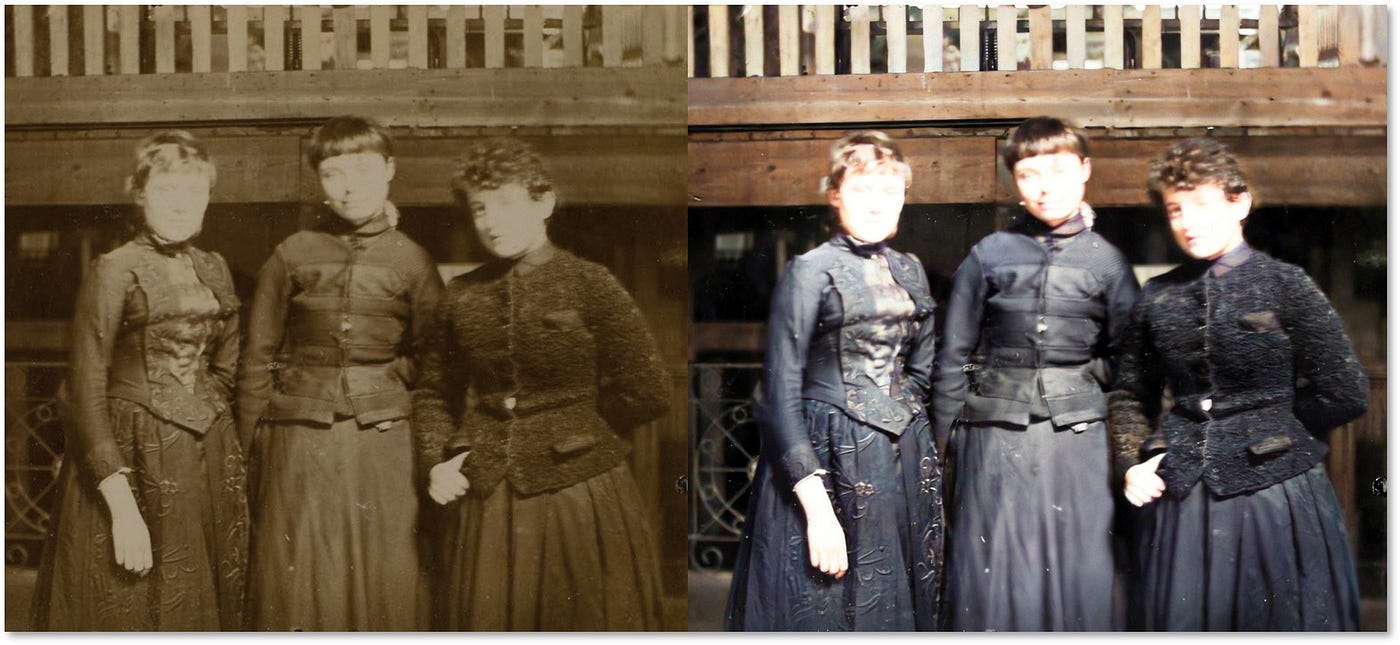
English singing girls as seen in original photo and after colorization and enhancement (via MyHeritage and Photoshop)
No names were given, but the caption grabbed my attention: “English singing girls — imported by Italian padrone — ret’d by Britannic, Nov 19 1890.”
As part of my series about immigrants featured in the virtually unknown E.W. Austin collection of 1890–1892 photos, I’ve enjoyed writing about Percy Hemingway, Sultana Numeir, and the Lillicrap family, but this trio was nameless. Could I even figure out who they were?
Thinking the caption details might help, I dug into UK and Ireland, Incoming Passenger Lists, 1878–1960 looking for their ship, but there seemed to be a gap in the relevant time frame, so it had managed to escape the clutches of this database. And even if I had found it, would I have been able to pluck them out amid all the other passengers?
Now what? Well, it was a long shot, but maybe they made the papers. Consulting several online newspaper resources, I experimented with searches using words such as Italian, English, girls, and variations of singing, but even restricting them to November 1890 turned up too many possibilities, none of which jumped out. Then I added “Barge Office” (Ellis Island was being constructed so hadn’t opened yet), and was startled to turn up dozens of pertinent articles.
Not only had the girls’ tale of woe made the papers, it had done so across America and the Atlantic. Now I had the names of the girls in the photo: Jessie Mason, Sarah Wibrow, and Kate Murphy.
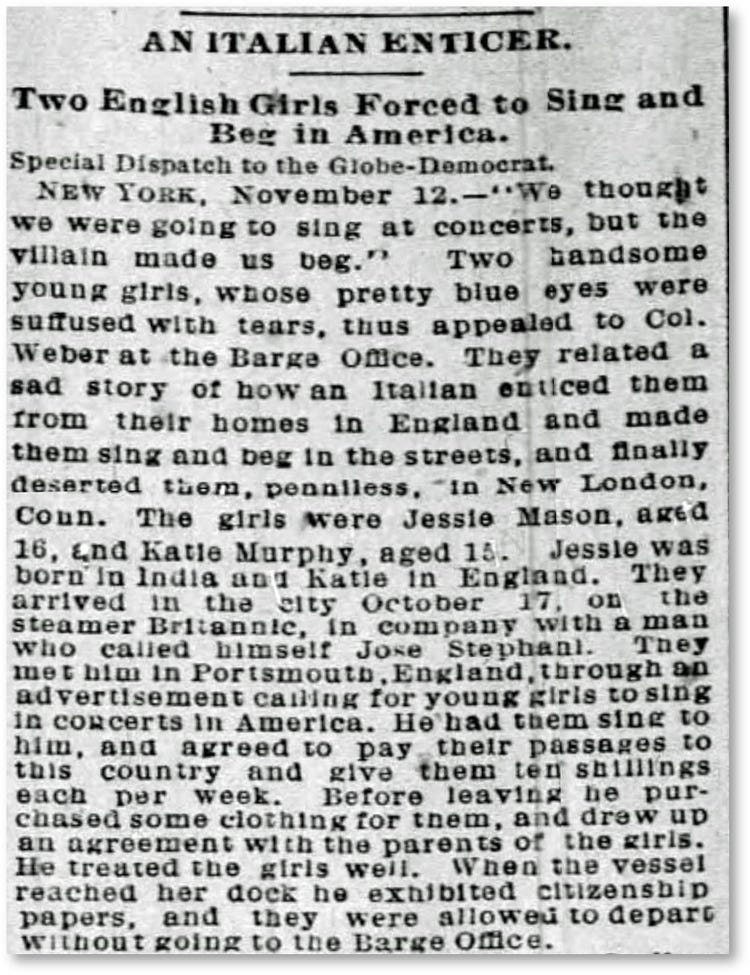
Excerpt from one of many articles about the girls, St. Louis Globe-Democrat, 13 November 1890 (Newspapers)
Reading the assorted accounts, I learned that these three teenagers, all from the vicinity of Plymouth, England, had come to America with an Italian man named “Jose Stephani” (I would eventually determine that his name was Giuseppe di Stefano) who sometimes went by Joseph Stevens (and yes, he repeatedly bounced back and forth between Italian and Anglicized versions of his name).
The purpose of the trip was to earn money singing, but having just read Hallie Rubenhold’s The Covent Garden Ladies, I feared that Giuseppe might have been a gently disguised pimp. Some red flags were evident. For example, the girls claimed that he had told them to pretend to be his daughters to avoid questions or even detention and deportation, and an inspection of their departure and arrival manifests showed that this was true. Sarah and Jessie had been passed off as his daughters, while Kate was logged as the child of Pasquale Palumbo, another man Giuseppe had brought along.
They also said that they skipped the usual immigrant processing because Giuseppe knew an official who treated them as American, and “Joseph Stevens” and his alleged family were indeed recorded as American.
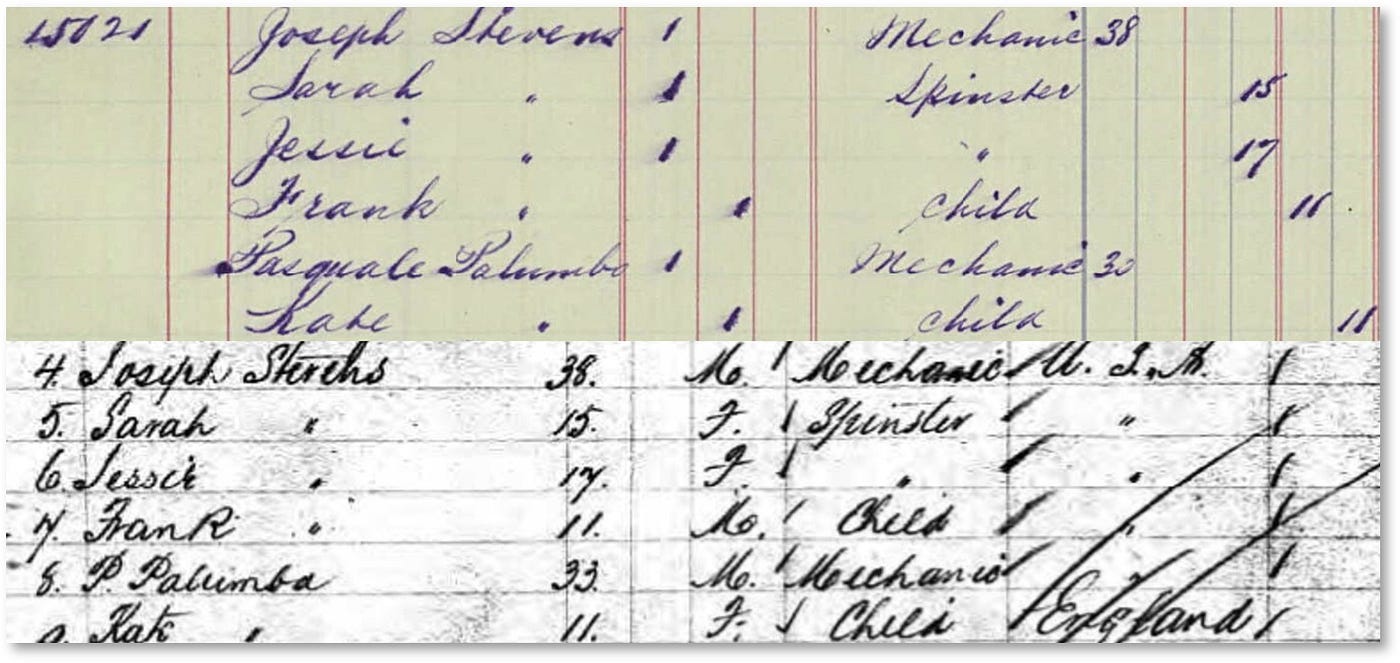
U.K. departure and NY arrival records for the girls and their supposed fathers (Ancestry)
All of this happened more than 130 years ago and I had only just learned the girls’ names. Even so, I found myself worrying about them. And that was before I learned that in spite of what some of the paper trail said, they were only 14 and 15 years old.
But as I continued to dig, I began to find reasons to exhale.
Giuseppe had obtained permission from the girls’ parents to take them on this trip, and the parents had even consulted with the local police. He was a family man and had brought his 11 year-old son, Frank (note his name in the passenger lists above). Giuseppe pointed out that he had taken previous journeys like this with some of his own children, and he and Pasquale were both musicians, harpists to be exact.
With the help of Barge Office, New York-based British, and shipping line officials, the girls were safely shepherded back to England, but that wasn’t the end of the story. Even before their return, numerous articles covering both sides began to appear in British newspapers as Jessie and Giuseppe had sent letters home, which their families shared with the media to support their respective versions of events.
But the overall tone and message was consistent: Giuseppe was a con man who had taken advantage of these innocent girls. All of this might have faded away upon their return if Giuseppe hadn’t felt so injured by the experience that he sued one of the local newspapers for libel the following year.
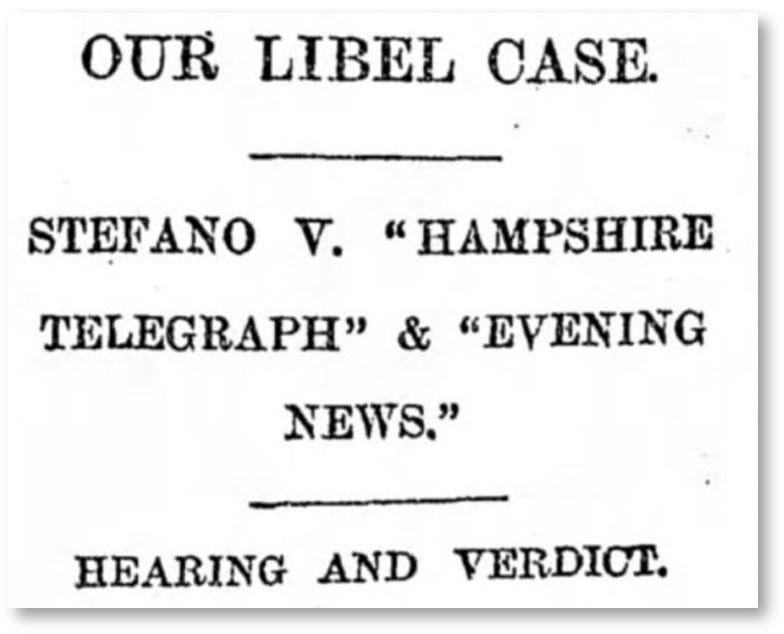
Hampshire Telegraph and Naval Chronicle, 14 November 1891 (Newspapers)
This resulted in detailed reporting from the trial, including one article that was almost a full page and featured sketches of the teenagers. Giuseppe said that his reputation had been so damaged that he could no longer make a living or support his family, and he was shunned by everyone. And though it was the newspaper that he had sued, the outcome was a classic he-said/she-said courtroom battle featuring Giuseppe and Jessie. Sarah and Kate also made cameo appearances, but Jessie — the youngest one who had only been 14 at the time of the trip — was the center of attention.
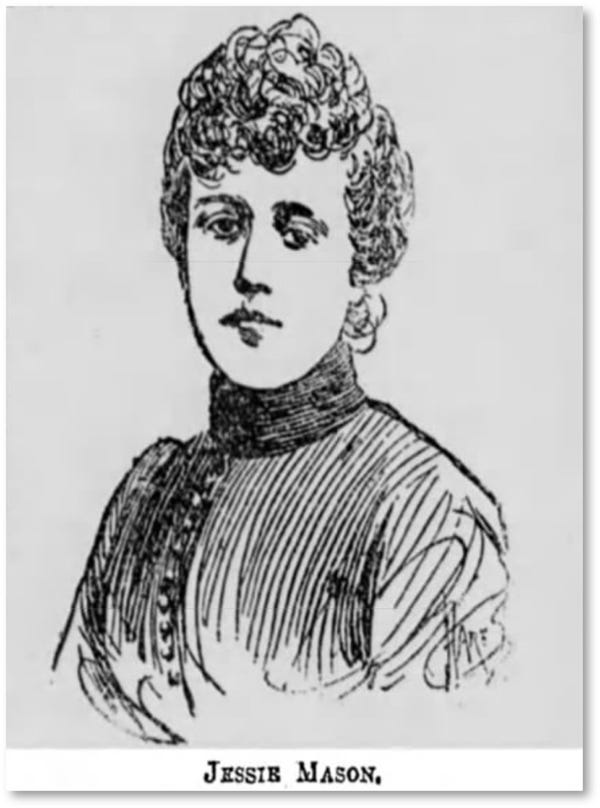
Hampshire Telegraph and Naval Chronicle, 14 November 1891 (Newspapers)
Jessie explained that they had been told they would sing in concerts, not on the street. She lamented about being forced to beg after singing in Brooklyn and several cities in Connecticut, and how Giuseppe had abandoned them with no money and even taken most of their clothing. And Pasquale, she complained, had made overtures which she had to fend off with a hatpin.
Giuseppe claimed that they had known all along that they were to sing in the streets, and their parents had agreed. He recounted that as soon as they got to America, the girls absconded with members of the ship’s crew, and his son had discovered them in a dancing saloon. Sarah was such a poor singer that Giuseppe left her with his sister in New York, and arranged for her to work in a candy factory while he took the other girls to Connecticut to perform, but once there, he said that Jessie refused to work and co-opted Kate. They insisted that they wanted to go home immediately, but he said that they needed to at least earn enough to pay for their fares, and this is what led to their standoff.
As to Pasquale, Giuseppe admitted that he had made inappropriate remarks, but even the girls acknowledged that Giuseppe had rebuffed him. And the only clothing he took, he said, were items he had purchased for them to perform in. The one thing all parties agreed on was that it was unexpectedly cold, and that made every aspect worse for all of them. Giuseppe had been planning on taking Jessie and Kate south before the stalemate occurred.
Both sides had naturally offered versions that made themselves the wronged victims so I wondered how the jury would decide, especially since the girls would not necessarily have been regarded as children at the time. The issue at hand was the newspaper’s coverage, but I couldn’t imagine how the jury members would be able to keep whichever rendition they accepted from coloring their ruling.
In the end, they decided in favor of Giuseppe, but only awarded him £1 — a hollow victory by any standard. This was the moment I realized that I had to see what had become of both Giuseppe and Jessie. They had emerged as the two main characters in the drama this photo of the English singing girls had unearthed, and my curiosity had been unleashed. Little did I know that by the time I was done, I would have consulted records from England, Scotland, and Wales, as well as Italy, the U.S., Canada, Ireland, Malta, India, Mexico, South Africa, Tanzania, and Australia (the last four and Scotland pertaining to their descendants).
. . .
My starting point was Italy where Giuseppe di Stefano was born in the southern town of Spinoso in 1850. Sometime in the 1870s, he emigrated to the British Isles, and once there, was drawn to seaside communities, living in Swansea, Bristol, and the Isle of Wight. He married a woman from Bristol named Emma Jones and they began a family and eventually settled in Portsmouth. In her trial testimony, Emma mentioned that she had spent 14 years singing in the streets, so perhaps that was how she and Giuseppe met.
Around 1886, he ventured across the Atlantic for the first time and determined that the market for busking was more lucrative in America and Canada than in England — enough so that he could cover travel costs and still make it worthwhile. It didn’t hurt that he had a sister living in New York, which would have helped minimize his costs when he stayed there. So began a pattern of his popping over to North America, sometimes solo and sometimes with youngsters (his children, but others as well) who would accompany his harp playing with their voices. In fact, the trip that went so badly in 1890 had been his second to New York that year.
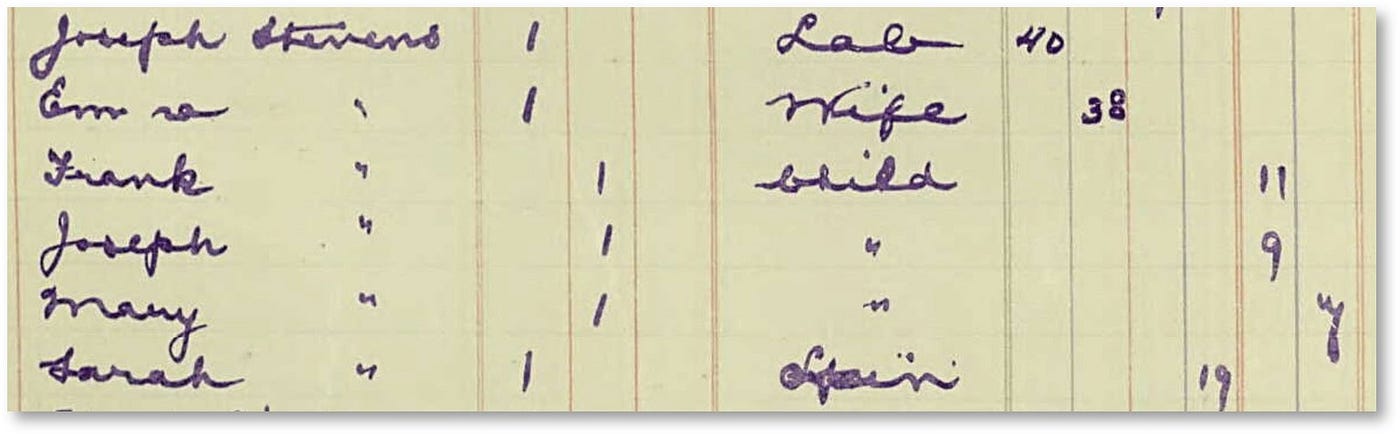
Giuseppe and his family going to Canada, 24 March 1892 (Ancestry)
The turmoil of the 1891 trial that stemmed from that voyage was the final straw for Giuseppe who reacted by packing up his family and moving to Canada several months later. His wife, Emma, gave birth to another daughter there, but it seems her heart was back in England, so just ten months later, she returned bringing their children with her. In 1895 she gave North America one last try, but after that, she parked herself in Portsmouth. Giuseppe spent the second half of the 1890s “crossing the pond” again — to Montreal, Boston, New York, and other cities.
Around the turn of the century, it became clear that Giuseppe and Emma were at an impasse and finally went their separate ways. The 1900 U.S. census found Giuseppe in New York with four of their children, while the 1901 U.K. census showed Emma on her own back in Portsmouth.
Not surprisingly, their children raised in this nomadic fashion were as casual about crossing the ocean as travelers today would be about taking the train from New York to Washington, D.C., so plenty of departures and entries can be uncovered for them. Ultimately, their sons mostly stayed in America (one went home after hitting hard times) and their daughters all opted for England. In all likelihood, the deciding moment — especially for the younger ones — was Giuseppe’s 1908 death in Manhattan. If he still had them busking, they were now free to make other choices.
So that was Giuseppe’s story. What about Jessie’s?
. . .
Jessie Mason had a rough start to life. Her mother, Sarah, married in England in late 1873 and moved to India with her new husband, only to lose him soon after. She swiftly remarried to Robert Mason, and gave birth to Jessie in Lucknow in 1876 and another daughter in 1878. Six months later, her second husband died.
The young widow went back to England and wed a third time to a man named Henry Knight, and promptly moved back to India where she had another daughter. The family then lived in Ireland and London before winding up in Aldershot, in the same county as Plymouth. In addition to explaining why Jessie appears in records as both Mason and Knight, this vagabond upbringing sheds light on why she might have been more open to the prospect of an American sojourn than most 14-year-olds of that era.
By 1890, Jessie’s mother was in desperate circumstances. She now had six children, the youngest born in March, and her husband was unemployed. So when the di Stefano couple approached her about Jessie going to America, it would have been tempting.
Giuseppe was looking for young singers to bring to the U.S. on his next trip, so he and his wife brought the Knight family to Plymouth (apparently they had a mutual acquaintance) and helped them find housing. Once there, Jessie’s mother checked with the local police, and while they cautioned her against sending her daughter abroad, they didn’t offer any specific warnings about Giuseppe. Add to this the fact that Jessie was hankering to go and even had a girlfriend who could go with her. Sarah caved.
By 1891, the entire family — including Jessie — was back in Aldershot, but not for long. Later that same year just two weeks after the trial, Jessie married Alfred Faulkner. Like her mother, she had selected a husband in the military, so wound up giving birth to her first two children in Malta and the next two in India, the country of her own birth.
By 1901, they were back in England and things seemed to be going well — that is, until the following year when her husband was accused of fraudulent use of public money. In 1903, he was convicted, sentenced to a year in prison and to be “discharged with ignominy,” and then disappeared from their lives.
Jessie presumably struggled for a few years until remarrying to William Skinner in 1907 and having two more children. And then she found herself back in the news in 1910 when her supposedly dead first husband re-materialized and threatened her. She claimed she had been told that he was dead. Maybe this was true or maybe it wasn’t, but the end result is that he was returned to custody.
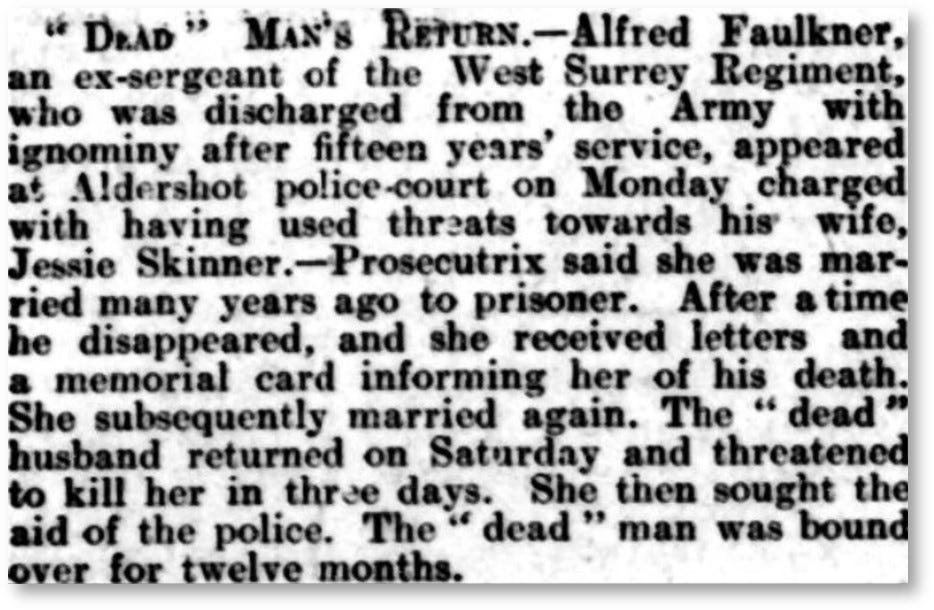
Hampshire Observer and Basingstoke News, 5 October 1910 (FindMyPast)
Whether this episode was a factor or not, a year later in the 1911 census, she declared herself a widow and was living alone with her three youngest. It’s worth noting, though, that she was tallied twice in this census as she was visiting her mother and stepfather when they were recorded, and in their household, she was listed as married. Whatever the circumstances, her second husband was out of the picture.
Following in the footsteps of her mother, Jessie took a third husband in 1913 — a younger man named Joseph Barker who had been born the same year she had her American adventure. In this case, the third time was the charm as Jessie had two more children and stayed with Joseph until her passing in 1937. That he loved her dearly can be seen in her tombstone:
We saw her fading like a flower
But could not make her stay
We tended her with greatest care
Till God took her away
I shall remember
While the light lasts
And in the darkness
I shall not forget
After all this sleuthing, it struck me that while Giuseppe and Jessie had sparred with each other, it may well have been because they were cut from the same cloth. Both were enterprising and restless wanderers on a constant quest for something better. Giuseppe/Joseph di Stefano/Stevens, it seems, never found what he was looking for, but Jessie (Mason/Knight) Faulkner Skinner Barker finally stumbled upon her soft landing, one that endured for the last quarter century of her life.¹
¹ As with the previous articles in this series, I have researched descendants, and once again, all indications are that none of them is aware of this story or their connection to it. I will reach out to them and share a link, and should any choose to share their reaction, I’ll provide an update.
. . .
UPDATE: I heard back from Angie Reijo, a great-great-granddaughter of Jessie’s and this was her reaction: “What a wonderful story you pieced together! This was not a story I was aware of. No surprise it was my ancestor who put her foot down, wrote home, and sought help from authorities. She knew how the world worked. She knew the value of a contract.”
Leave A Comment